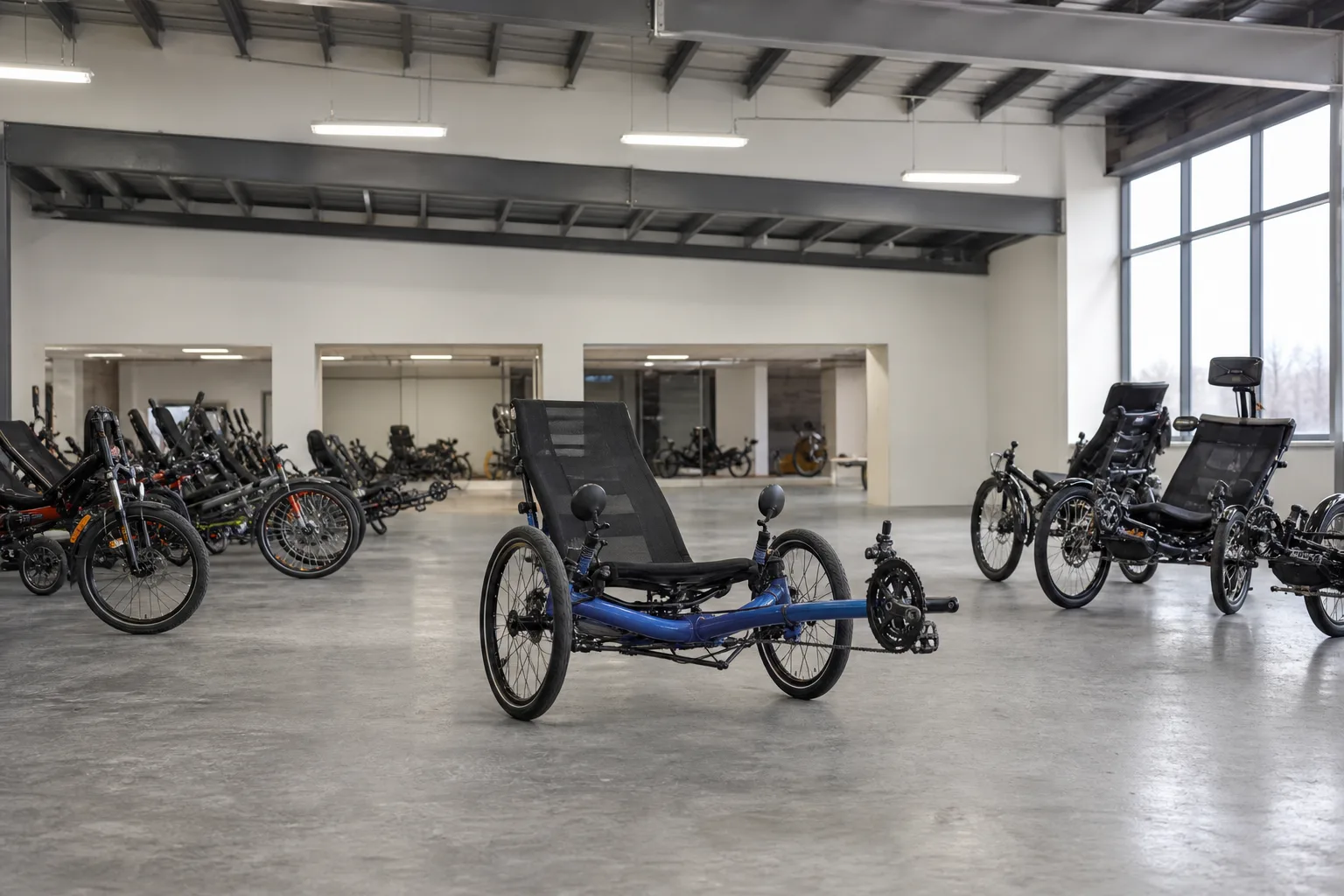
The first surprise on an adult three-wheeler usually arrives within the first mile, at a corner taken at a speed that would have been unremarkable on a two-wheeled bike. The machine does not lean. It stays flat, the rider's body keeps traveling in the old direction, and the inside wheel goes light or leaves the pavement entirely. Nothing has gone wrong mechanically. A tricycle simply resolves cornering forces differently, and the sooner a buyer understands that difference, the more sensibly they can judge the frames on the shop floor.
What replaces lean, and why it runs out
On a bicycle, the rider leans into a turn until the combined force of gravity and cornering runs down through the tire contact patches, which is why a two-wheeler feels stable at almost any survivable speed. A trike cannot do this. The cornering force acts at the combined center of mass of rider and machine, and it is resisted only by the width between the wheels. Whether the inside wheel stays down comes down to a ratio: half the track width divided by the height of the center of mass. Wide and low stays planted. Narrow and tall does not.
That ratio explains most of what riders report. An upright delta trike with the saddle a yard off the ground and roughly thirty inches of track has a modest margin, and it disappears quickly, because cornering force rises with the square of speed. Doubling from six miles per hour to twelve quadruples the load trying to lift the inside wheel. A recumbent tadpole with the seat a foot off the ground and similar track has several times the margin, which is why those machines can be cornered hard enough to scrub the tires rather than lift.
The crown of the road is not neutral ground
American roads are built with a crown, a transverse slope that sheds water toward the curb, and it is typically slight, on the order of a quarter inch of drop per foot of width. A two-wheeled rider absorbs this without noticing. A trike does not. On a crowned road, the machine is already tilted downhill toward the gutter, and the center of mass has been moved sideways before any cornering begins. Turning toward the curb on that slope stacks the two effects, so a right-hand turn into a driveway can lift the left wheel at a speed that felt safe seconds earlier on level pavement.
Driveway aprons, bike path edges where the shoulder falls away, and the exaggerated crown near storm drains are all worth respecting for the same reason. So are parking lot ramps taken diagonally, which put one wheel high and one low while the rider is also steering. None of this makes a trike unsafe. It makes the machine directional in a way two wheels are not, and riders who learn to read pavement slope the way they already read potholes stop being surprised by it within a few weeks.
Testing this before money changes hands
An empty commercial parking lot on a weekend morning is the right place, ideally one with a visible slope so the crowned-road case can be reproduced deliberately. Bring a few tennis balls or paper cups as markers. Ride a steady circle of roughly twenty feet in diameter in both directions, starting slowly and adding a little speed each lap until an inside wheel goes light. Do this on the flat first, then on the slope, turning downhill, which is the demanding case. The point is not to tip. It is to find where the warning begins, because on most trikes the inside wheel lifts noticeably before anything irreversible happens.
A careful shopper checks a short list during that session. Note the speed at which the wheel first lifts, in each direction, on flat ground and on the slope. Note whether shifting the shoulders and head toward the inside of the turn recovers it, since on higher machines that counter-lean buys real margin. Check tire pressure before and after, because a soft front tire on a tadpole rolls under and mimics a stability problem. Ask the shop for the track width and the seat height as numbers, then compare candidates on those two figures rather than on impressions.
What the numbers are worth on the spec sheet
Track width on adult trikes generally runs from the high twenties to the mid thirties in inches, and an extra three inches of track is worth more than it sounds, both for cornering and for the crowned-road case. Seat height matters at least as much, and it is where recumbent designs earn their reputation. The Consumer Product Safety Commission oversees bicycle safety requirements in the United States, and shops accustomed to those standards will usually supply frame geometry on request. Where a folding hinge or a wide cargo box is involved, ask specifically whether track width changes when the machine is set up for load.
The rider who has ridden the circles knows something a spec sheet cannot supply: what the machine feels like a moment before it protests. That number, in miles per hour, is the one worth carrying home.