A two-wheel rider who runs out of gear stands up and grinds the last hundred yards out of the saddle. On three wheels that option is gone. The seat is usually reclined or at least fixed, the pedals are ahead of the rider rather than below, and the whole machine weighs half again what a road bike does before anything is loaded into the basket. So the climb has to be solved sitting down, with cadence and torque, or with a motor. Both approaches work. They fail in different places, and the failures are what a careful buyer should be shopping for.
1. Work out the lowest gear you actually have, in inches
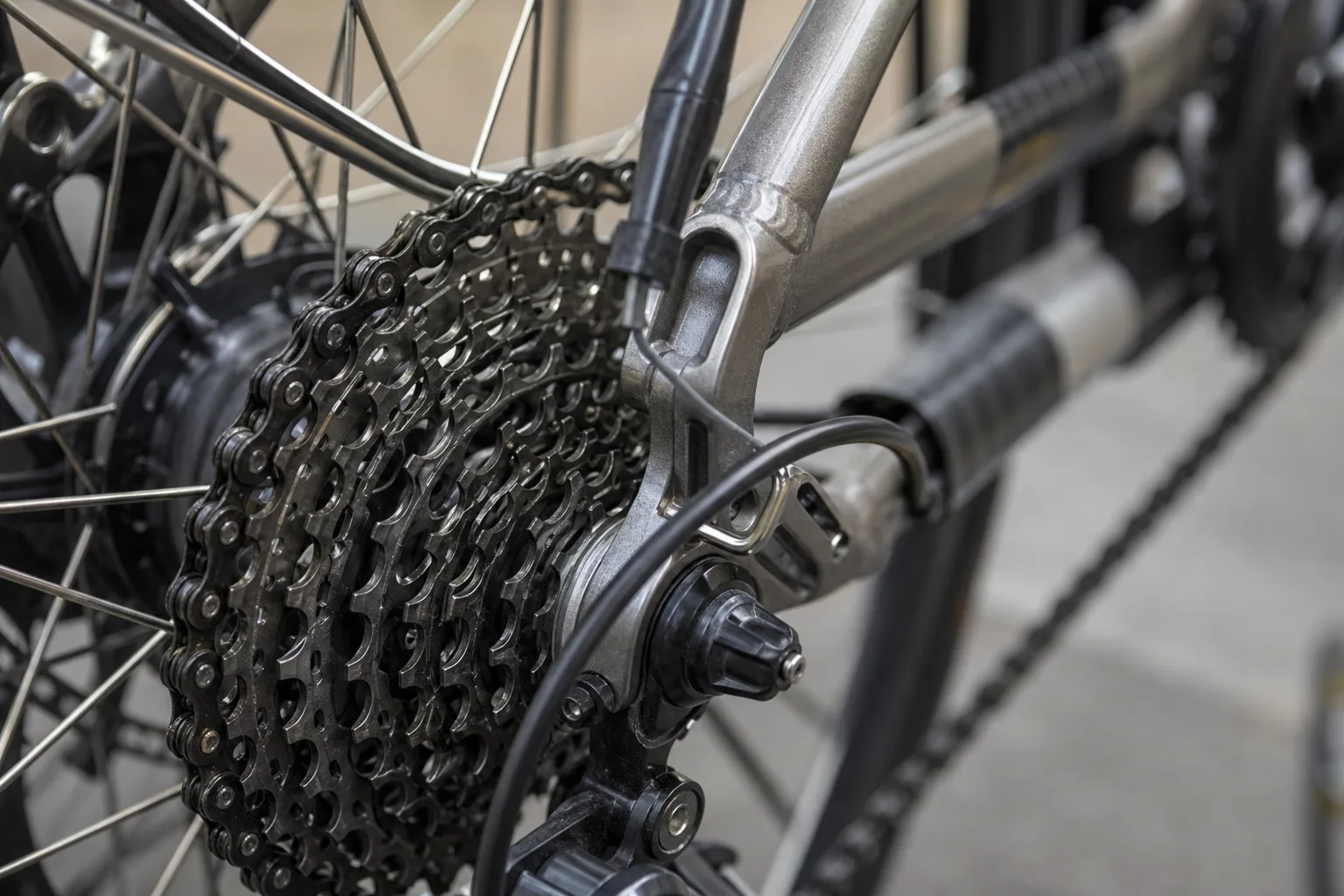
Gear range is sold as a number of speeds, which tells you almost nothing. What matters is the lowest development: the smallest chainring divided by the largest cog, multiplied by wheel diameter. A trike with a 30-tooth granny and a 42-tooth cog on 20-inch wheels lands somewhere near 14 or 15 gear inches, which is genuinely low, low enough that most seated riders can turn it up a sustained grade at a cadence they can hold. A 34-tooth low cog on a 26-inch wheel is a very different machine. Ask the dealer to compute it, or compute it yourself before the test ride, because a shop demonstration on flat pavement will not reveal the difference.
2. Understand what an internal hub buys and what it costs
Internally geared hubs, in eight, eleven, and fourteen-speed forms, shift at a standstill, tolerate weather and road salt, and remove the exposed derailleur that a trike tends to park on when it is wheeled sideways into a garage. That standstill shift matters more on three wheels than on two, because a trike stops where it stops and restarts on the grade rather than rolling out of it. The trade is efficiency and total range. Most hubs give up a small percentage in drivetrain drag, and the widest of them still may not reach as low as a well-chosen derailleur setup with a compact triple. A hybrid, an internal hub with a chainring change ahead of it, closes much of that gap.
3. Treat a modest motor as a torque problem, not a speed problem
For seated climbing the useful specification is starting torque, expressed in newton-meters, and whether the assist is controlled by a torque sensor or a cadence sensor. A torque sensor scales help to the pressure a rider actually applies, which suits someone with limited leg strength; a cadence sensor delivers a fixed amount once the cranks turn, which feels abrupt at the bottom of a driveway. A geared hub motor with meaningful low-speed torque will hold a slow grade better than a higher-wattage direct drive that wants to spin. The Consumer Product Safety Commission is responsible for bicycle and e-bike product safety in the United States, and the class labeling and battery certification you find on a machine are worth reading before the sales pitch.
4. Ask what rolling terrain does to the range figure
Advertised range is a flat-ground, light-rider, low-assist number. On rolling terrain the motor draws hard on every rise and recovers nothing on the descent, so real range on a hilly loop commonly comes in well under the printed figure. Watt-hours are the honest unit: multiply voltage by amp-hours, then ask the dealer roughly how many watt-hours per mile that model consumes under the assist level you would actually use. Plan the return trip on a depleted battery and a heavy machine. A trike that pedals acceptably with the power off is a different proposition from one that does not, and that question is answerable in the parking lot.
5. Count the weight where it lands
A hub motor and battery typically add somewhere in the range of fifteen to twenty-five pounds, and where those pounds sit changes the machine. A rear hub motor on a tadpole trike puts mass behind the axle, which improves rear grip on a climb and makes the tail heavier to lift onto a rack. A downtube or seat-frame battery keeps weight low and central, which helps cornering stability. That same weight is the argument for keeping the low gears even on an electric trike: a wide-range cassette costs a few pounds at most, and it is what gets a fully loaded machine home if the pack runs flat on the far side of the hill.
The two solutions are not rivals so much as different insurance policies, and the strongest specification is usually both: gearing low enough to climb unassisted at a walking pace, plus enough assist to make that climb pleasant rather than merely possible.